
Fitchburg City Directory Holdings
No official source identified a separate complete Fitchburg directory run. The substantial regional shelf is Madison’s, while the Fitchburg Historical Society supplies local rural and land-oriented sources. That limitation is useful: it prevents unsupported claims that every edition covered every Fitchburg home.
| Collection | Years or scope | Where held | Access |
|---|---|---|---|
| Madison city directories | 1858 to 1921 digitized; complete printed set reported locally | UW Digital Collections and Madison Central Library | Online scans and reference use |
| 1958 rural directory and plat book | 1958 | Fitchburg Historical Society | Appointment; reference only |
| Dane County plat books | 1862 reprint, 1935, 1968, 1972, 1974, 1984, 1985, 1999, 2008 | Fitchburg Historical Society | Appointment; no checkout |
| Fitchburg History Room | Local artifacts, photos, articles, obituaries, and referrals | Fitchburg Public Library | Library visit; society help by appointment |
| HeritageQuest | Directories 1821 to 1989; census 1790 to 1940 | Madison Public Library e-resource | Library authentication may apply |
| Otto Schroeder Archives | Published and unpublished Dane County material | Dane County Historical Society | Appointment; possible staff-copy charge |
| Oak Hall Cemetery records | Cemetery since 1857 | City and local history channels | No verified online interment index |
Directories were not issued annually until after 1950. For any gap, check the closest volume before and after the date, then test census, deed, cemetery, and newspaper sources.
Why Fitchburg Directories Say Madison
Fitchburg’s proximity to Madison shaped both postal labels and printed coverage. A person on land now inside Fitchburg may appear under Madison, Town of Fitchburg, or an older local place name. A modern city boundary should never be projected backward onto an old directory without checking its coverage notes.
Search Madison and Fitchburg, then try Oak Hall, Syene, Swan Creek, Lake View, Stoner’s Prairie, and Town of Fitchburg. Before 1853, Greenfield may be the right term. Fitchburg took its current name because the older Greenfield label caused postal confusion with Greenfield in Milwaukee County. That local naming story turns a failed surname search into a second, historically sound pass.
Early Fitchburg-Area Directory Scans
UW Digital Collections’ 1871 to 1872 Madison volume is a full-view scan with title, creator, and publisher metadata. Historic Madison identifies an online run from 1858 through 1921. Search multiple adjacent years and inspect both the alphabetical pages and coverage matter. Do not assume that the sample volume includes a Fitchburg resident until the scan itself confirms one.
Other cataloged nineteenth and early twentieth-century volumes appear in the collection, but no complete year-by-year online list was verified. Cite the actual volume, publication year, printed page, and image position. A transcription hit is a lead. The scan is the record that shows spelling, abbreviation, neighboring entries, and page context.
Decode a Fitchburg Directory Entry
A city directory entry can connect a name to a spouse or household note, occupation, business, and street address. Business entries may show a firm, officers or owners, classification, and address. The symbols differ by publisher and year, so photograph or save the abbreviation key before interpreting marks.
| Name | Surname, given name, initials, and sometimes a spouse or relationship note |
|---|---|
| Work line | Occupation and sometimes a business connection |
| Residence | Street number, road, or place description as printed |
| Status clue | Edition-specific mark for widow, boarder, roomer, owner, or renter |
| Placement | Alphabetical page or back-of-book street section |
| Citation | Publisher, volume year, printed page, and image number |
- Criss-cross directory
- The address-ordered section that reverses the usual name search.
- Householder index
- An edition’s list centered on household heads or named householders.
- Abbreviation key
- The publisher’s guide to shortened street, relationship, and status terms.
Absence is not proof that someone had left. Rural homes, people between editions, new streets, renters, and women printed under a spouse’s name may be missed.
Fitchburg’s 1958 Rural Directory
The 1958 Dane County Plat Book and Rural Directory is the strongest Fitchburg-specific bridge between an agricultural community and later suburban records. It can pair a surname or farm with road and land context where a Madison city directory may not reach. The volume is held by the Fitchburg Historical Society and requires an appointment.
Compare it with the society’s 1935, 1968, 1972, and 1974 plat books before jumping to a modern street number. Land divisions and road labels can change. Match the historic farm or owner against a modern parcel PIN, legal description, and deed chain. This method is safer than assuming a rural-route number became today’s house number.
Fitchburg History Room Research
The Fitchburg Historical Society works from the Fitchburg Room on the second floor of Fitchburg Public Library. Its holdings include photographs, articles, obituaries, artifacts, and plat books. Volunteers assist with early settlers, historic sites, farms, and local families. Society office hours are by appointment, and the published phone is 608-729-1783.
This is a physical research setting, not a downloadable master directory. Bring the full name, spelling variants, date range, neighborhood or farm name, and any known address. Ask staff which item should be consulted and whether copying is permitted. The library building opened in 2011, but the records describe a much older community.
Regional Shelves for Fitchburg Names
Historic Madison’s research guide points to Madison Public Library’s Local Materials and second-floor Local History Room at 201 W. Mifflin Street. The library holds the complete Madison directory set reported by the local guide, plus newspaper microfilm, clipping files, local documents, yearbooks, phone material, and genealogy databases. Reference staff can help identify the right shelf.
HeritageQuest includes more than 1.5 million city and county directory records dated 1821 to 1989, plus census images through 1940, local histories, cemetery sources, and land maps. Access conditions may require a library card or in-library login. Save the scan and its metadata, not only a search-result transcript.
View the Historic Madison regional research sources.
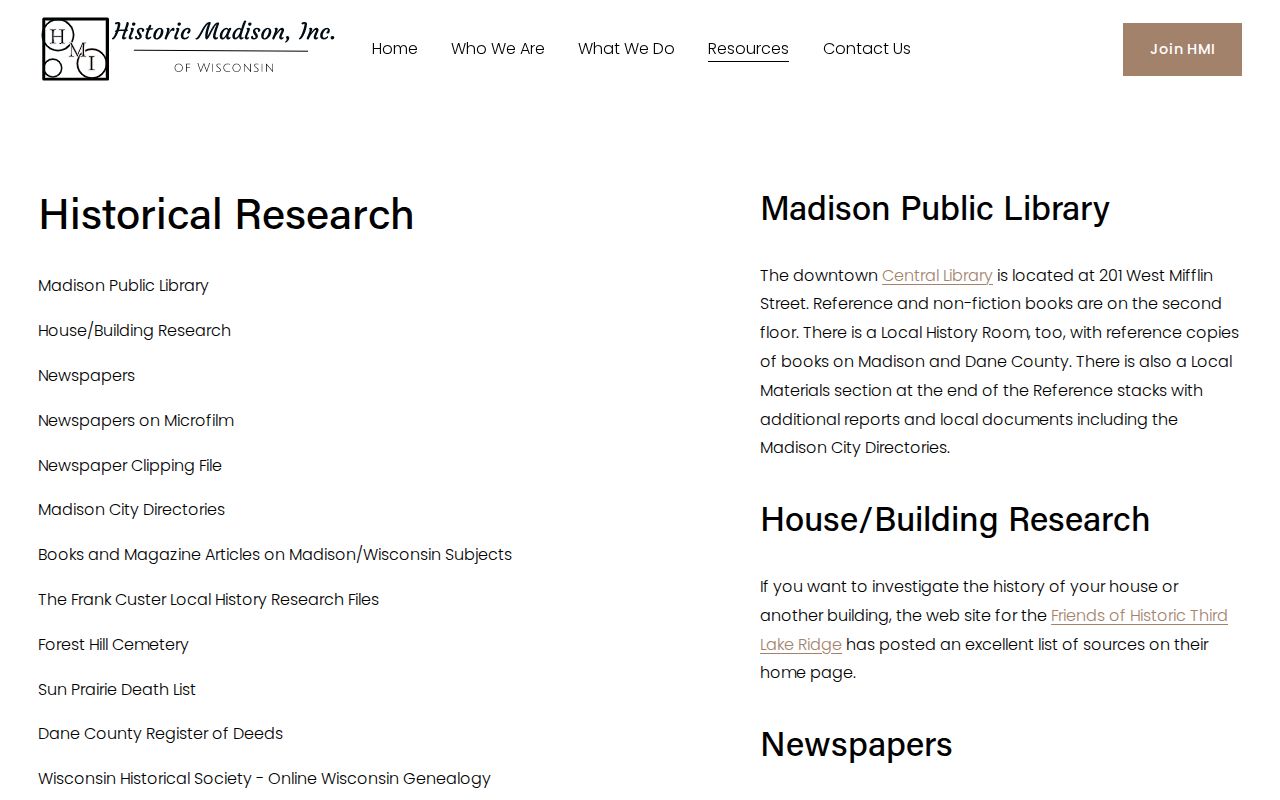
The captured page provides a regional route to directories and house records when a dedicated Fitchburg shelf cannot answer the question.
Trace Families Across Fitchburg Editions
A directory is strongest when treated as one dated observation. Follow a person through several volumes, record every change, and then compare those entries with a federal census or local source.
- Start with the known name or reverse-search the known address, preserving its exact spelling.
- Check initials, married or former surnames, and nearby alphabetical entries in the same edition.
- Repeat at five-year or census-year intervals, then fill the years around a move.
- Compare public federal census years from 1850 through 1940, noting that a census and directory reflect different collection dates.
- Bridge rural Fitchburg with the 1958 directory and plat, then match land through the PIN and deed description.
- Close a life trail with an obituary, probate file, or cemetery record when appropriate.
A changed address, spouse note, or work line can support an identity match but is not conclusive alone. Keep each finding tied to its edition and combine independent sources.
Oak Hall’s Fitchburg Kinship Trail
Oak Hall Cemetery has existed since 1857 and became city-owned in 1987. Its interment records, plats, and plot contracts preserve a people record distinct from a city directory. A marker or cemetery entry can help anchor a death and family group, though it does not prove a current or former street address by itself.
Use an obituary to identify relatives and a last residence, then compare probate records for heirs or estate land. St. Mary’s and church cemetery files may supply other leads. No verified public Fitchburg interment search was found, so the city, church, Historical Society, and library are the proper fallback channels.
Fitchburg Directory Place Names
The timeline explains why one household may appear under several labels. It also prevents a modern Fitchburg city directory search from overlooking town and county sources.
| Year | Record-keeping change | Search effect |
|---|---|---|
| 1847 | Town of Greenfield formed | Use Greenfield in early land and community material |
| 1853 | Name changed to Fitchburg | Search both town names near the transition |
| 1857 | Oak Hall Cemetery established | Add cemetery records to family research |
| 1858 | Online Madison directory run begins | Check whether each edition reaches the target place |
| 1958 | Dane rural directory and plat published | Connect farm households to land |
| 1983 | Fitchburg incorporated as a city | Separate earlier town records from city files |
| 2022 | Part of Town of Madison attached | Municipality changed while some mailing labels stayed |
Limits of Fitchburg City Directories
No verified complete local city-directory run, citywide renumbering event, or Fitchburg-specific Sanborn sheet year was found. A Madison volume may omit rural Fitchburg. A directory can also miss unlisted people, new arrivals, residents between editions, and people printed under another household name.
Dane County Historical Society’s Otto Schroeder Archives is an important fallback. Its predecessor records center began in 1968 through a partnership with Madison Public Library and Dane County Library Service, which helps explain why historic county sources are dispersed among custodians, libraries, and archives. Contact the archive by appointment; copies may involve staff charges. A growing digital subset is available through Recollection Wisconsin.