
Fitchburg Previous Resident Sources
No single roll identifies everyone who lived at a Fitchburg address. Land records follow title, directories capture selected residents or firms, and a census records a household on one enumeration date. Begin with the source closest to the period in question, then compare it with a second record. This distinction is vital when the property was leased, divided into units, or known by a rural route.
| Source | Years It Covers | Where Held | What It Shows |
|---|---|---|---|
| Dane deed index | Online from January 1975; earlier records vary | Register of Deeds, Tapestry, Laredo | Parties, recording date, document type, PIN or land description |
| Madison city directories | Early online run identified for 1858–1921; print set extends later | UW Digital Collections and Madison Public Library | Selected names, addresses, occupations, spouses, firms, reverse entries |
| Dane rural directory and plats | 1862 reprint, 1935, 1958, and later editions through 2008 | Fitchburg Historical Society | Rural names, roads, farms, plats, and land context |
| Federal census | Public schedules through 1940 in HeritageQuest | Library database | Household members as counted on one date |
| Permits and code files | Coverage must be confirmed by request | City of Fitchburg custodian | Work, applicant, contractor, inspection, and address evidence |
For recent ownership, start with the current parcel and deed index. For a mid-century farm, the 1958 rural directory and nearby plat years may be more useful. For nineteenth-century previous residents, use deeds, census schedules, cemetery sources, and old place names rather than expecting a modern street number.
Anchor Fitchburg Records by PIN
The free AccessDane parcel search supplies the current parcel identification number, municipality, situs address, billing address, legal description, assessment data, and links to recorded documents. A situs address is the physical property location. The billing address is where tax mail goes. Matching addresses can suggest an owner lives there, but they do not prove it.
Search by any part of the street address and omit the municipality in quick mode. If that misses, use Advanced Search with Fitchburg as the municipality, or search by owner, parcel, subdivision, certified survey map, lot, block, building, or unit. Save the PIN and full legal description before going further. Those land keys persist when a house number or postal label changes.
Search tip. Repeat a Dane deed search by party name, PIN, and legal description because the working index can contain errors or omissions.
Trace Fitchburg Resident Deeds
A deed chain links transfers of the same land. The Dane County Register of Deeds recommends checking grantor and grantee names, the PIN, and the legal description. Its online index begins in January 1975 while back-indexing continues. Earlier paper indexes, tract books, microfilm, or help at the Madison office may be needed.
- Copy the current owner, PIN, and legal description from AccessDane.
- Find that owner's purchase deed in the Register of Deeds index and record its document number, date, and seller.
- Search the seller as a grantee to locate the deed by which that seller acquired the property.
- Repeat the grantee-to-grantor link, checking the land description at each transfer.
- At the online cutoff, call or visit the office for paper books, microfilm, and earlier tract material.
- Grantor
- The person or entity transferring an interest in land.
- Grantee
- The person or entity receiving that interest.
- Chain of title
- The sequence of recorded transfers for the same property.
- Legal description
- The plat, lot, block, survey, or metes-and-bounds text that identifies land apart from its mailing address.
Fitchburg Deed Records Access
Occasional online researchers can use Tapestry EON, while frequent users have the Laredo Anywhere option. Tapestry charges $8.75 for a successful search and $1 per image page. The county describes free in-office viewing, with copies at $2 for the first page and $1 for each added page. A certified copy adds $1 per document.
Mail is a real fallback, not an afterthought. A request should include the document number, volume and page when known, recording year, page count, a money order, and a stamped self-addressed envelope. The county estimates about two weeks. The Dane County Register of Deeds is in Room 110 of the City-County Building, 210 Martin Luther King Jr. Boulevard, Madison, and public hours are weekdays from 8 a.m. to 4 p.m. Real-estate search help is available at 608-266-4144 during the office's stated phone windows.
The successful manifest capture shows the Tapestry recorded-document gateway used for Dane County searching.

The county choice and party fields lead into a paid index workflow, while an office visit remains useful for older or hard-to-read records.
Fitchburg Rural Directory Bridge
The Fitchburg Historical Society holds a notably useful run of local plat books: an 1862 reprint, editions from 1935, 1958, 1968, 1972, 1974, 1985, 1999, and 2008, plus a 1984 atlas and City of Madison map. The 1958 volume combines a Dane County plat book with a rural directory. It bridges the years when farms and rural routes may not appear cleanly in Madison's urban directories.
These books are reference items and cannot be checked out. Contact the Society for an appointment in the Fitchburg History Room at the public library. Compare a farm surname and road in the 1958 directory with the nearby plat editions, then match the land to the current PIN and deed chain. That method is safer than assuming a modern number existed in the same form decades ago.
Fitchburg Place-Name Records
Place names can break an otherwise careful search. The area became the Town of Greenfield in 1847 and took the Fitchburg name in 1853 after postal confusion with Greenfield in Milwaukee County. Fitchburg incorporated as a city in 1983. The 2022 Town of Madison attachment changed government services and voting context, yet residents were told to keep their mailing addresses.
Search old sources under Greenfield, Town of Fitchburg, City of Fitchburg, and Town of Madison. Add historic nodes such as Oak Hall, Syene, Swan Creek, Lake View, Stoner's Prairie, Dogtown, and Fitchburg Village. A Madison, Oregon, or Verona mailing label may still sit on a parcel within Fitchburg government boundaries. No verified citywide street-renumbering year was found, so do not invent one. Let the legal description and PIN connect the eras.
Match Fitchburg Residents by Year
Owners are only one layer of previous residents. A directory may show a person, spouse notation, occupation, business link, and address. Its reverse section starts with a street address or telephone number. Madison Public Library holds the full Madison directory set, and UW Digital Collections offers early scanned volumes, including an identified 1858–1921 run. Coverage of rural Fitchburg must be checked page by page.
- Search the reverse section for the exact address, spelling, direction, and number.
- Check the alphabetical entry for name variants, initials, spouse notes, work, and residence.
- Repeat in nearby editions and record the volume, year, page, and publisher.
- Compare public federal census years through 1940, noting that a census reflects one date while directory data may have been gathered earlier.
- Use the rural directory, plat books, and deeds where the city directory does not reach.
The collection details and abbreviation issues are covered more fully in the Fitchburg city directory. Absence is not proof that no one lived there. Rural households, recent arrivals, people listed under another household name, and homes outside a publisher's route can be missed.
Map Fitchburg Address Records
Plat books show ownership and land layout, not a full household. Building permits can add dates, named applicants, contractors, inspection events, and the type of work, but no public Fitchburg permit search was verified. Submit a specific request to the city custodian with the address, record type, and date range rather than asking for an open-ended history.
Sanborn fire insurance maps can help document a building footprint, material, use, and changes where sheets exist. The research did not verify a particular Fitchburg sheet or year. The Recollection Wisconsin Sanborn collection is the right starting point for checking coverage.
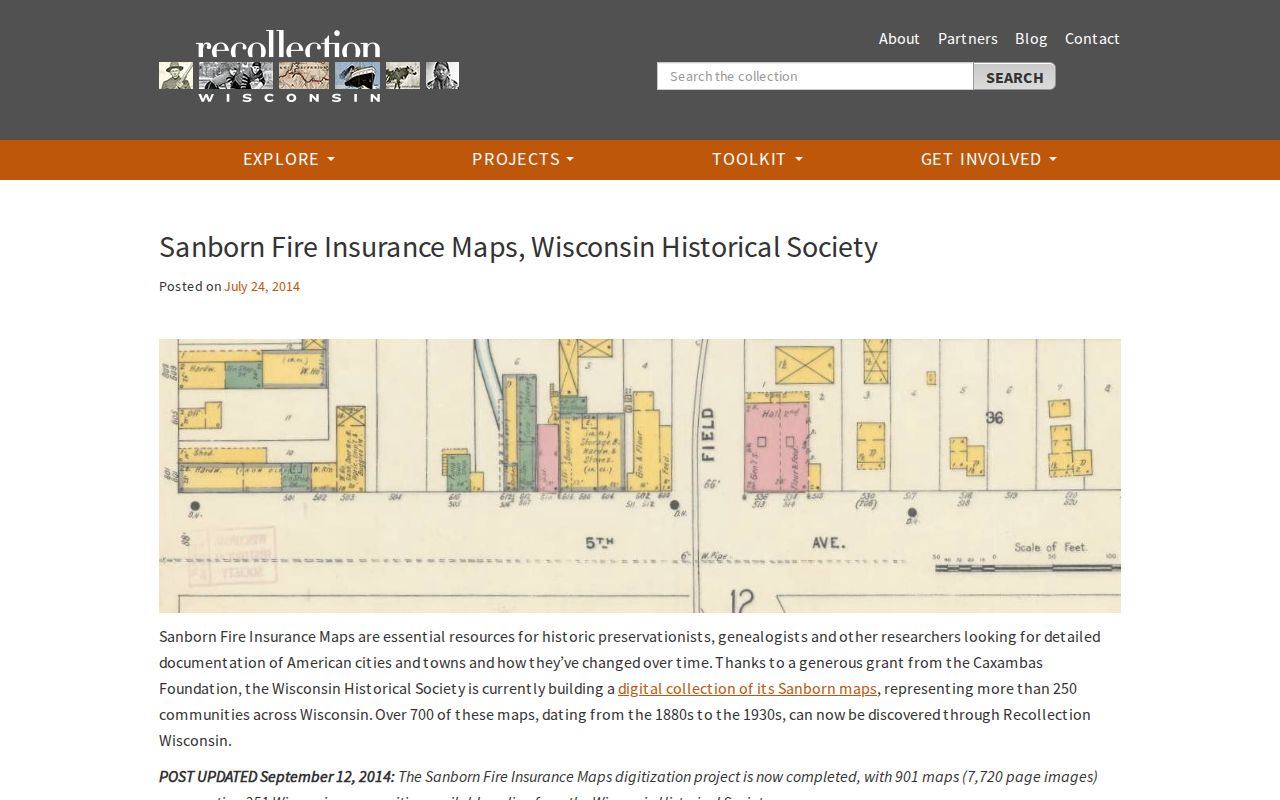
Confirm the city, sheet, date, and address before treating any map as evidence for a Fitchburg structure.
Close a Fitchburg Resident Trail
Obituaries, probate, and cemetery records can resolve what happened after a person left an address. The Fitchburg Historical Society keeps obituary files in the Fitchburg History Room. Madison library newspaper microfilm and clipping files offer a regional route when a name and rough date are known. Cite the newspaper, date, and page, then compare names with a deed or original record.
Dane County probate files may name a decedent, personal representative, heirs, addresses, and estate land, subject to confidential filings. The Probate Office charges $4 to search when no case number is supplied, $1 per page for certified or uncertified copies, and $3 for a certificate. Requests can go to the records email, by mail, or in person at the Dane County Courthouse. Oak Hall Cemetery, established in 1857 and city-owned since 1987, adds a distinct local kinship trail through interment and plot records.
Lawful use. Research previous residents for house history, genealogy, or estate questions. Never use an address trail to follow, intimidate, or harm a living person.